
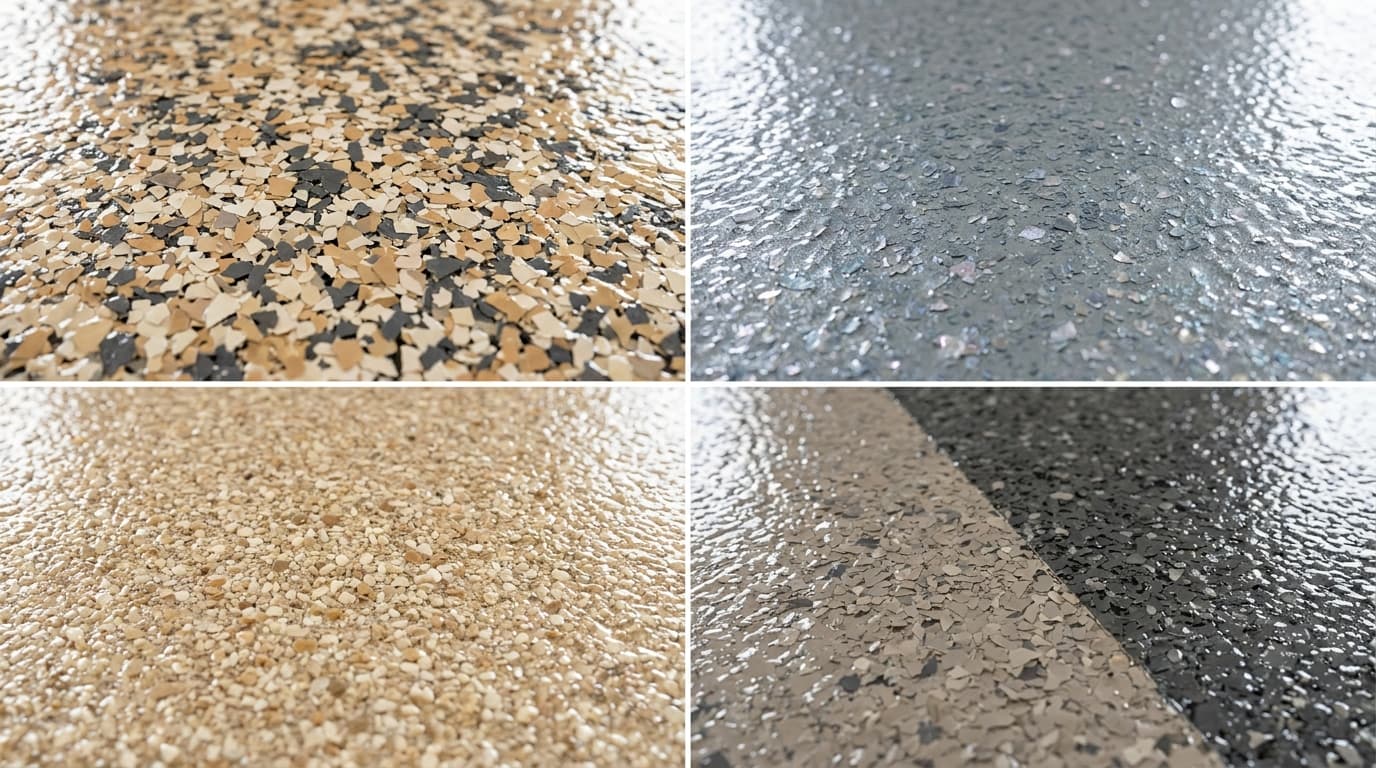
Diamond Concrete Coating's decorative basement floor product is a polyaspartic coating with a custom decorative flake broadcast — we do not install stained, polished, or overlay concrete. The seven most popular flake-system options for Ohio basements are full-flake multi-color blends, partial-flake modern minimal, solid satin color, metallic-look flakes, designer custom palettes, quartz broadcast for gyms, and two-tone zoned flake. All are built on a moisture-tolerant polyurea base coat with a UV-stable polyaspartic topcoat and a 15-year warranty.
If you're finishing a basement in Cleveland, Beachwood, Solon, or anywhere in Greater Cleveland, you've probably seen Pinterest boards full of stained concrete, polished concrete, and decorative overlays. We don't install any of those. What we do install — and the only thing we install for decorative basement floors — is a polyaspartic flake system that outperforms every one of those alternatives on durability, moisture tolerance, and design flexibility. This guide walks through the seven flake-system options we actually offer, what each one looks like, and which one fits a home gym vs. a home office vs. a finished rec room.
Why Diamond only installs polyaspartic flake systems (not stained or polished concrete)
Stained concrete and polished concrete look beautiful in a magazine. In a Northeast Ohio basement, they fail. Stained concrete is a topical reaction — acid or water-based dye sitting in the pores of the slab — and it does nothing to seal the floor against vapor pushing up from clay soil. Polished concrete is the slab itself, ground and densified, with no protective coating. Both finishes telegraph every crack, every cold joint, and every old patch repair. And both lose their finish anywhere moisture migrates through the slab.
A polyaspartic flake system is a different category of product. The polyurea base coat bonds to a diamond-ground slab and tolerates vapor transmission that would lift stained or polished finishes off the floor. The flake broadcast hides minor imperfections, patches, and texture variation. The polyaspartic topcoat seals everything in with a chemical-resistant, scratch-resistant, color-stable finish that holds up to gym equipment, furniture, dog claws, and decades of foot traffic.
Everything below is a polyaspartic flake system. The base chemistry is identical on every option. What changes is the flake — the size, the color, the density of the broadcast, and how we work it into the room. That's where the design happens. For the full basement service overview, see our basement and indoor spaces page.
Option 1: Full-flake multi-color blends (most popular)
Full-flake is the workhorse of decorative basement floors. We broadcast color flake to refusal — meaning the wet polyurea base is completely saturated with flake — then scrape and topcoat with polyaspartic. The result is a dense, granite-like surface with rich color depth and a slight tactile texture underfoot.
Multi-color blends are where the design comes in. Earth-tone blends (warm browns, terra cottas, and creams) read traditional and pair well with finished basements that lean toward family-room or den use. Cool-tone blends (charcoal, slate gray, and white) read modern and work in home offices and rec rooms with minimalist furniture. We bring physical sample boards to every estimate so you can see exactly what each blend looks like at full square footage.
Best fit: any basement where you want a forgiving, design-forward finish that hides imperfections in the slab. This is what we install most often in Greater Cleveland, and it's the option homeowners default to when they don't have a strong preference one way or the other.
Option 2: Partial-flake decorative (modern minimal)
Partial-flake is the same flake system at a lower broadcast density. Instead of saturating the base coat, we broadcast a measured amount of flake so the underlying base color shows through between the flake pieces. The finish reads more like a designer terrazzo than a granite — graphic, modern, intentional.
Partial-flake works especially well in basement home offices and contemporary finished spaces where the floor is meant to recede rather than dominate. Pair a charcoal polyaspartic base with sparse white-and-gray flake and you get a floor that looks custom-designed to match modern furniture without screaming for attention.
Best fit: modern, minimal basements. Home offices. Walkout basements with a contemporary aesthetic. Spaces where you want the floor to be a clean, considered design element rather than the focal point.
Option 3: Solid satin polyaspartic color
Solid satin is the same polyaspartic system with no flake at all. The base coat is pigmented to your chosen color and the polyaspartic topcoat seals it with a satin sheen. It's the cleanest, most contemporary finish in our lineup — and the most affordable, because we skip the flake broadcast step.
The trade-off is forgiveness. With no flake, the finish shows the underlying slab. Any patching, crack repair, or texture variation reads through the coating. For a basement with a smooth, recently poured slab, solid satin is gorgeous. For an older basement with patches and old joint repairs, full-flake or partial-flake hides those imperfections far better.
Best fit: newer basements with clean slabs, homeowners who want a single-color modern finish, or spaces that will be heavily furnished where the floor doesn't need to do the visual heavy lifting.
Option 4: Metallic-look flake (mimics stained concrete aesthetic)
This is the option for homeowners who came in wanting stained concrete. Metallic-look flake uses pearlescent and metallic-pigmented flake — coppers, bronzes, pewters, deep slate — broadcast into a tinted polyaspartic base. The finish has the moody, depth-of-color look of an acid-stained floor, with movement and variation that feels organic rather than mass-produced.
Unlike actual stained concrete, metallic flake doesn't fade, doesn't telegraph cracks, and doesn't lose its finish where moisture migrates through the slab. Because basements have no UV exposure, the metallic pigments hold their color indefinitely. We've installed metallic-look flake basements going on five years that still read exactly like the day they were finished.
Best fit: homeowners who want the high-design stained-concrete look without the durability and moisture problems. Finished basements with curated furniture and lighting. Spaces where you want the floor itself to be a conversation piece.
Option 5: Designer custom color palette
Every option above starts from our standard color library. If none of those work for your basement, we'll build a custom palette. That can mean blending two or three of our standard flakes in a custom ratio, sourcing a specific accent flake to pull a color from your furniture or finishes, or working from a paint-deck color you bring to the estimate.
We've matched flake palettes to everything from kitchen-cabinet stains to specific area rugs. The base chemistry doesn't change — it's the same polyurea-and-polyaspartic system underneath. What changes is the flake recipe. We mock up custom palettes on a sample board before install day so there's zero guesswork on the finished color.
Best fit: homeowners working with an interior designer, basements with high-end finishes already in place, or anyone who wants a floor that's specifically tuned to the rest of the room.
Option 6: Quartz broadcast flake (home gyms)
Quartz broadcast is a different aggregate — colored quartz crystals instead of flexible flake — broadcast at high density into the polyaspartic base. The finish has a coarser, grippier texture than standard flake. It's what we recommend for basement home gyms because the surface texture gives you real traction underfoot, even with bare feet or chalked hands, and the dense aggregate handles dropped dumbbells and impact loads without showing damage.
Quartz comes in earth-tones and grays, broadcast either to refusal for maximum texture or partial for a slightly smoother feel. The polyaspartic topcoat is chemical-resistant, so spilled pre-workout, rubber-mat off-gassing, and the occasional protein shake clean up with a damp mop.
Best fit: basement home gyms, dedicated workout rooms, and multi-use spaces where part of the basement is functional and part is finished living space — quartz in the workout zone, full-flake in the lounge area.
Option 7: Two-tone zoned flake (rec rooms, offices)
Two-tone zoned flake breaks the basement floor into design zones using two different flake blends — usually with a clean line between them — to visually define a workout area from a lounge area, a home office from a hallway, or a bar area from a TV zone. The whole floor is still one continuous polyaspartic system; the zoning happens at the flake-broadcast step, where we mask off zones and broadcast different blends into each section.
Done well, two-tone zoning gives a finished basement the same kind of room-definition that an area rug provides — without the rug. Done poorly, it looks like a hardware-store DIY. The line work matters. We use clean, taped breaks at architectural transitions (door openings, post lines, the edge of a bar) so the zoning reads as intentional design, not as a seam where two crews started and stopped.
Best fit: large finished basements with multiple functional zones. Multi-use rec rooms. Walkout basements with distinct living areas. Any space where one floor color across the entire square footage would feel flat.
How polyaspartic + flake compares to stained and polished concrete
If you came in wanting stained or polished concrete, here's the honest comparison. Stained concrete is gorgeous on day one and unreliable past year three in a basement. The stain has no protective film over it — every spill, every scuff, every moisture event etches the finish. Polished concrete has no protective film at all; the slab itself is the finish. In a basement with any vapor transmission, it loses its sheen wherever moisture comes through. And both finishes telegraph every crack and every old patch in the slab.
Polyaspartic with flake delivers the same design ambition — and in the case of metallic-look flake, the same visual aesthetic — with a permanent protective film over the top. The floor is moisture-tolerant. It's chemical-resistant. It hides slab imperfections instead of highlighting them. And it carries a 15-year warranty that no stained or polished concrete contractor in Northeast Ohio will match. For more on why coating chemistry matters in Ohio basements specifically, read our breakdown on why basement floor coatings fail in Ohio clay soil and our Cleveland basement floor coating guide.
Which flake system is right for a home gym vs. a home office vs. a rec room?
Home gym: quartz broadcast as the default, full-flake multi-color if aesthetics matter more than grip. Both sit on the same polyurea base coat. Quartz gives you traction and impact resistance; full-flake gives you a more designed look at the cost of slightly less surface texture.
Home office: partial-flake or solid satin in a cool-tone palette. The floor should feel calm and intentional, not busy. Partial-flake in a charcoal base with sparse white flake reads professional and modern. Solid satin in a deep gray is even cleaner if the slab will support it.
Finished rec room or family space: full-flake multi-color, metallic-look flake, or two-tone zoned. Full-flake earth-tones work in traditional family basements. Metallic-look flake works where the basement is more design-forward. Two-tone zoned works when the rec room covers a large footprint with distinct functional areas.
If you're not sure, that's what the estimate is for. We bring sample boards of every option, walk the basement with you, and recommend a system based on how you actually plan to use the space. We coat basements all over Greater Cleveland — including our Beachwood service area — and we'd rather spend an extra ten minutes upfront getting the design right than rush a homeowner into a finish they don't love.
Frequently Asked Questions
Does Diamond install stained or polished concrete basements?
No. Diamond exclusively installs polyaspartic coatings with decorative flake broadcasts. If you want a stained-concrete aesthetic, our metallic-look flake option achieves that visual with significantly better durability, moisture tolerance, and a 15-year warranty. We won't quote stained or polished concrete because we don't believe either holds up in an Ohio basement.
Do decorative flake finishes cost more than solid color?
Slightly. Multi-color flake and metallic-look flake run roughly $1–$2 per square foot above a solid satin color, all within our overall $7–$10 per square foot installed range. Quartz broadcast for home gyms sits at the upper end of that range. Two-tone zoned flake adds modest labor for the masking and zone work but no significant material cost.
Can I see samples before I decide?
Yes. We bring physical flake sample boards to every estimate — every blend in our standard library plus any custom palettes we've worked up for your project. You'll see and touch the actual finish at full scale before you commit to anything.
Does a flake finish hide imperfections?
Yes — and this is one of the biggest reasons full-flake is our most popular option. Full-flake in particular hides minor patching, surface texture variation, and prior crack repair. If your basement slab has been through decades of life — a sump-pump pit cut in, old plumbing patches, hairline cracks — full-flake reads as one continuous, intentional finish over all of it.
Will metallic flakes fade in a basement?
No. Basements have no UV exposure, and our polyaspartic topcoat is itself UV-stable, so metallic and pearlescent flake pigments hold their color indefinitely. We have metallic-look flake basements approaching their fifth year that look identical to install day.
Which flake system is best for a home gym?
Quartz broadcast for grip and impact resistance, or heavy full-flake for aesthetics. Both sit on the same polyurea base coat with the same polyaspartic topcoat — only the broadcast aggregate changes. Quartz is the right call if you're dropping weights and want bare-foot traction. Full-flake is the right call if the gym shares space with finished living areas and the look matters more than the grip.
Bring your basement vision to our next estimate — we'll bring the flake sample boards. Call 440-821-7220.